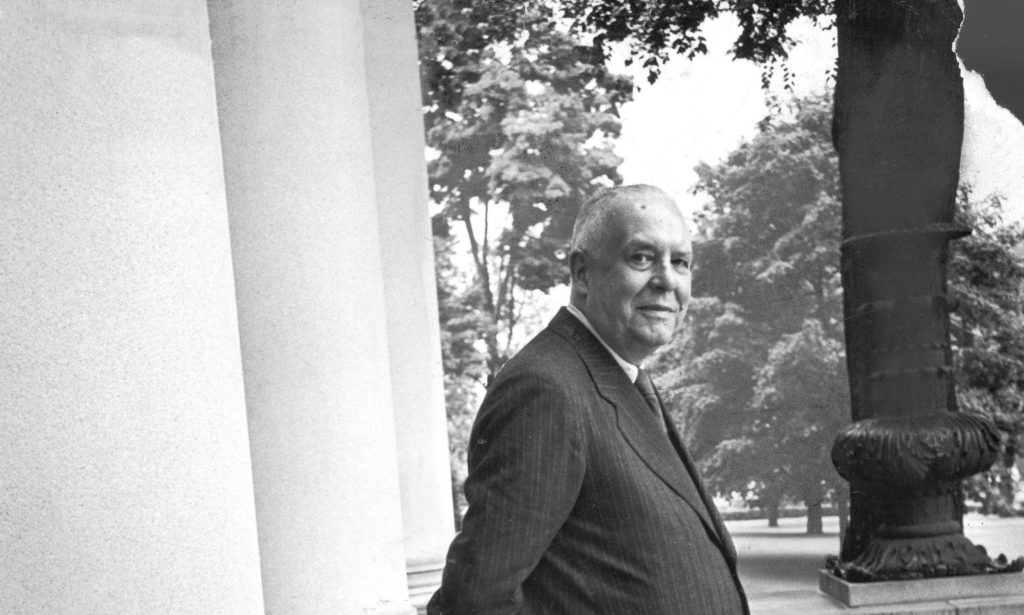
A un vecchio filosofo a Roma
di WALLACE STEVENS
[da “The rock”, 1954]
Sulla soglia del cielo, le ombre nella via
si fanno ombre celesti, il maestoso moto
di uomini che si rimpiccioliscono, lontani,
cantando con voce sempre più fioca
un’assoluzione oscura e un congedo –
La soglia, Roma, e quella Roma più clemente
oltre, gemelle nella mente che le forgia.
Come se, in una dignità umana,
due parallele si fondessero in una,
prospettiva di cui l’uomo è parte, nel palmo e nel miglio.
Con che leggerezza gli stendardi al vento si mutano in ali…
Ciò che si oscura all’orizzonte del vedere
diviene auspicio di sorte,
ma sorte dello spirito, oltre l’occhio,
non della sua sfera, eppure non troppo oltre,
Dove il finito tocca l’estremo dello spirito,
e il noto si curva sull’orlo dell’ignoto.
Il brusio degli strilloni
si fa un altro bisbiglio; l’odore acre
della medicina diviene una fragranza intatta…
Il letto, i libri, la sedia, le suore che passano,
la candela che sfugge allo sguardo:
sono queste le fonti d’una Roma felice,
una forma nel cerchio delle forme antiche,
e queste sotto l’ombra d’un’altra forma
nel groviglio del letto e dei libri, presagio
sulla sedia, trasparenza che scorre sulle suore,
luce sulla candela che si lacera nello stoppino
per salire all’eccellenza sospesa, sfuggire
al fuoco ed essere solo ciò che
il fuoco significa: il possibile celeste.
Parla al tuo cuscino come fosse te stesso.
Sii oratore, ma con lingua esatta,
senza eloquenza, o tu, mezzo addormentato,
della pietà che è il memoriale di questa stanza,
così che sentiamo, in questa vastità illuminata,
l’autentico minuscolo, così che ciascuno
si rifletta in te e nella tua voce
ascolti la sua, maestro e uomo da compiangere,
immerso nelle tue particelle di non-fare,
nel dormiveglia profondo della veglia,
nel tepore del letto, sull’orlo della sedia, vivo
ma diviso tra due mondi, impenitente
verso l’uno, e nell’altro pieno di pena,
impaziente per la grandezza che cerchi
in tanta miseria; eppure trovandola
solo nella miseria, soffio della rovina,
poesia arcana dei poveri e dei morti,
come l’ultima goccia del sangue più profondo,
quando cade dal cuore e resta lì, visibile,
come il sangue d’un impero, forse,
per un cittadino del cielo, sebbene ancora di Roma.
È la voce della povertà che più ci cerca,
più antica della più antica voce di Roma.
Questo è l’accento tragico della scena.
E tu – sei tu che lo pronunci, senza parole,
la sillaba più alta tra le più alte,
l’unico invulnerabile tra
rozzi capitani, la nuda maestà, se vuoi,
degli archi come nidi e delle volte scolpite dalla pioggia.
I suoni filtrano, gli edifici riaffiorano,
la città non ti lascia, né tu vuoi che lo faccia.
Essa abita la tua stanza,
le sue cupole sono l’architettura del tuo letto.
Le campane ripetono nomi solenni
in cori e in cori di cori,
riluttanti a fare della misericordia un mistero
di silenzio, o che una solitudine interiore
ti conceda più di ciò che danno
le loro armonie e le eco che tremano nei sussurri.
È una sorta di grandezza totale, alla fine,
dove ogni cosa visibile si amplia, eppure
resta nulla più che un letto, una sedia, suore in movimento,
il più immenso teatro, il portico con colonne,
il libro e la candela, nell’ambra della tua stanza,
la grandeur totale d’un edificio totale,
scelto da un inquisitore di forme
per se stesso. Si ferma su questa soglia,
come se il disegno di tutte le sue parole
trovasse qui misura, forma e compimento.
*
To an Old Philosopher in Rome
On the threshold of heaven, the figures in the street
Become the figures of heaven, the majestic movement
Of men growing small in the distances of space,
Singing, with smaller and still smaller sound,
Unintelligible absolution and an end –
The threshold, Rome, and that more merciful Rome
Beyond, the two alike in the make of the mind.
It is as if in a human dignity
Two parallels become one, a perspective, of which
Men are part both in the inch and in the mile.
How easily the blown banners change to wings…
Things dark on the horizons of perception
Become accompaniments of fortune, but
Of the fortune of the spirit, beyond the eye,
Not of its sphere, and yet not far beyond,
The human end in the spirit’s greatest reach,
The extreme of the known in the presence of the extreme
Of the unknown. The newsboys’ muttering
Becomes another murmuring; the smell
Of medicine, a fragrantness not to be spoiled…
The bed, the books, the chair, the moving nuns,
The candle as it evades the sight, these are
The sources of happiness in the shape of Rome,
A shape within the ancient circles of shapes,
And these beneath the shadow of a shape
In a confusion on bed and books, a portent
On the chair, a moving transparence on the nuns,
A light on the candle tearing against the wick
To join a hovering excellence, to escape
From fire and be part only of that which
Fire is the symbol: the celestial possible.
Speak to your pillow as if it was yourself.
Be orator but with an accurate tongue
And without eloquence, O, half-asleep,
Of the pity that is the memorial of this room,
So that we feel, in this illumined large,
The veritable small, so that each of us
Beholds himself in you, and hears his voice
In yours, master and commiserable man,
Intent on your particles of nether-do,
Your dozing in the depths of wakefulness,
In the warmth of your bed, at the edge of your chair, alive
Yet living in two world, impenitent
As to one, and, as to one, most penitent,
Impatient for the grandeur that you need
In so much misery; and yet finding it
Only in misery, the afflatus of ruin,
Profound poetry of the poor and of the dead,
As in the last drop of the deepest blood,
As it falls from the heart and lies there to be seen,
Even as the blood of an empire, it might be,
For a citizen of heaven though still of Rome.
It is poverty’s speech that seeks us out the most.
It is older than the oldest speech of Rome.
This is the tragic accent of the scene.
And you – it is you that speak it, without speech,
The loftiest syllable among loftiest things,
The one invulnerable man among
Crude captains, the naked majesty, if you like,
Of bird-nest arches and of rain-stained-vaults.
The sounds drift in. The buildings are remembered.
The life of the city never lets go, nor do you
Ever want it to. It is part of the life in your room.
Its domes are the architecture of your bed.
The bells keep on repeating solemn names
In choruses and choirs of choruses,
Unwilling that mercy should be a mystery
Of silence, that any solitude of sense
Should give you more than their peculiar chords
And reverbations clinging to whisper still.
It is a kind of total grandeur at the end,
With every visible thing enlarged and yet
No more than a bed, a chair and moving nuns,
The immensest theatre, and pillared porch,
The book and candle in your ambered room,
Total grandeur of a total edifice,
Chosen by an inquisitor of structures
For himself. He stops upon this threshold,
As if the design of all his words takes form
And frame from thinking and is realized.
Scopri di più da Giuseppe Genna
Abbonati per ricevere gli ultimi articoli inviati alla tua e-mail.
