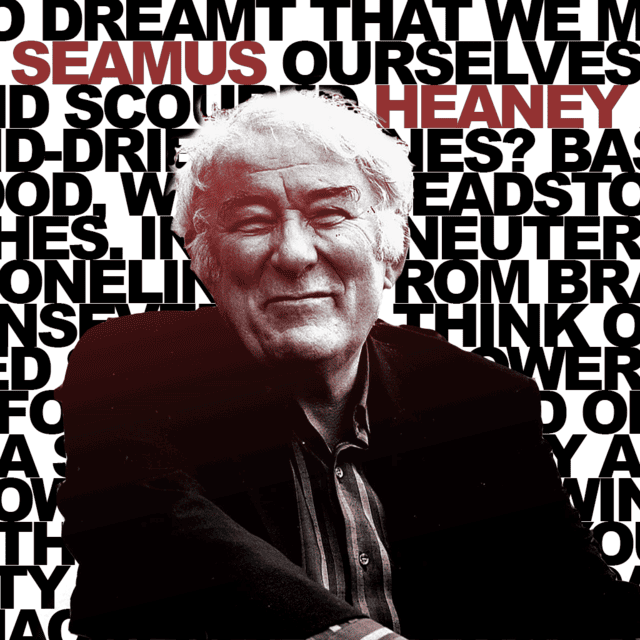
“Clearances” è un poemetto in morte della madre, una sequenza di otto stanze sonettate, dalla raccolta “The Haw Lantern”, uno dei capolavori del Nobel per la letteratura 1995, il grande poeta irlandese Seamus Heaney. Il titolo ha molteplici significati, tra cui il letterale “sgombero” o “svuotamento” di una vita, la creazione di spazio e il processo di rendere una casa “libera” o ordinata, alludendo anche alle sinistre clearances storiche, cioè gli “sgomberi” o “evacuazioni” di persone dalla loro terra.
In Memoriam M.K.H., 1911–1984
Mi insegnò ciò che suo zio le aveva insegnato:
quanto facilmente il più grosso blocco di carbone si spaccasse
se coglievi la venatura e inclinavi bene il martello.
Il suono di quel colpo pacato e seducente,
il suo eco cooptato e cancellato,
mi insegnò a battere, mi insegnò ad allentare,
mi insegnò, tra martello e blocco,
ad affrontare la musica. Insegnami ora ad ascoltare,
a fare scoccare la ricchezza dietro, linee come versi, il nero.
1
Un ciottolo lanciato cento anni fa
continua a raggiungermi, la prima pietra
mirata alla fronte rinnegata della bisnonna.
Il pony sussulta e il tumulto esplode.
Lei è rannicchiata nella trappola,
correndo la forca quella prima domenica
giù per il pendio verso la Messa, a galoppo terrorizzato.
Lui frusta attraversando la città e imprecando di “Lundy!”
Chiamatela “La Convertita”. “La Sposa Esogama”.
Comunque sia, è un pezzo di genere
ereditato dal ramo materno
e mio da congedare ora che lei non c’è più.
Al posto di argenti e merletti vittoriani,
la pietra che scusa e viene scusata.
2
Il linoleum lucido brillava. Brillavano i rubinetti in ottone.
Le tazze di porcellana erano così bianche e grandi —
un servizio intatto, con tanto di zuccheriera e bricco.
Il bollitore fischiava. Panini e focaccine per il tè: perfetti.
Perché non si sciogliesse, il burro al riparo dal sole.
E niente briciole. Non inclinare la sedia.
Non allungarti. Non indicare. Nessun rumore nel mescolare.
È il Numero 5 di New Row, Terra dei Morti,
dove il nonno si alza dal suo posto
con gli occhiali sollevati sulla testa calva e lucente
per accogliere una figlia ritornata e confusa
ancora prima che bussi. “E questo? E questo?”
E siedono insieme nella stanza splendente.
3
Quando gli altri stavano a Messa
io ero tutto suo e pelavamo patate.
Rompevano il silenzio, cadevano una a una
come stagno che piange da un ferro da saldare:
conforti freddi posati fra noi, cose da condividere
che brillavano in un secchio di acqua pulita.
E ancora cadevano. Piccoli schizzi così piacevoli
dal lavoro dell’altro ci risvegliavano dall’incanto.
Così, mentre il parroco al suo capezzale
con tutto se stesso recitava le preghiere dei morenti,
e chi rispondeva e chi piangeva,
io ricordai la sua testa piegata sulla mia,
il suo respiro nel mio, i nostri coltelli a pelare bucce in sintonia —
mai più vicini, per tutto il resto della vita.
4
La paura di sembrare affettata la portava
a mostrarsi inadeguata ogni qualvolta
si trattava di pronunciare parole “al di sopra di lei”. Bertold Brek.
Riusciva sempre a tirare fuori qualcosa di impacciato e storto
sempre, quasi potesse tradire
gli impacciati e gli inadeguati con l’uso
di un vocabolario troppo bene regolato.
Più per sfida che per orgoglio, mi diceva: “Tu
le sai tutte quelle cose lì.” E così io controllavo la lingua
davanti a lei – un’autentica, bene
regolata e adeguata forma di tradimento
di ciò che sapevo fare meglio. Dicevo naw e aye
e ricadevo con decenza nella grammatica sbagliata.
5
Il fresco che proveniva da lenzuola appena ritirate
mi faceva pensare che fossero ancora umide,
ma quando prendevo gli angoli del lino
e tiravo con lei, dritto sull’orlo
e poi in diagonale, quindi sbattevamo e tendevamo
la stoffa come una vela in vento incrociato,
ecco emettevano un colpo secco, essiccato e ondulante.
Così tiravamo e piegavamo e finivamo mano nella mano
per una frazione di secondo, come se nulla fosse accaduto,
perché nulla era accaduto che non fosse accaduto
da sempre, giorno dopo giorno: un tocca e fuggi,
un riaccostarsi tenendosi indietro,
in mosse dove io ero la X e lei era l’O
incisi sulle lenzuola cucite da sacchi di farina scuciti.
6
Nella prima vampata delle vacanze di Pasqua
i riti della Settimana Santa
erano il culmine della nostra fase “Figli e Amanti”.
Il fuoco di mezzanotte. Il cero pasquale.
Gomito a gomito, felici di inginocchiarci
uno accanto all’altra, lì in prima fila
nella chiesa gremita noi seguivamo testi
e rubriche della benedizione del fonte.
Come la cerva anela ai corsi d’acqua, così l’anima mia…
Immersioni. Asciugature. L’acqua respirata sopra.
L’acqua mista a crisma e olio.
Tintinnio della navicella. Incensazione solenne
e il grido del salmista sollevato con orgoglio:
Notte e giorno le lacrime furono il mio pane.
7
Negli ultimi minuti lui le disse più cose
quasi che in tutta la loro vita insieme.
“Sarai a New Row lunedì sera
e verrò a prenderti e sarai felice
quando entrerò dalla porta… Non è vero?”
La testa piegata su quella sorretta dai cuscini.
Lei non sentiva, però noi eravamo colmi di gioia.
La chiamò buona e ragazza. Poi lei morì,
si rinunciò a cercare il polso
e tutti capimmo una sola cosa rimanendo lì.
Lo spazio in cui ci trovavamo si era svuotato
dentro di noi, per restare; aveva penetrato
gli spazi liberati che all’improvviso si aprivano.
Le grida alte caddero e avvenne un puro mutamento.
8
Pensai di camminare in tondo in uno spazio
assolutamente vuoto, assolutamente sorgivo,
dove il castagno addobbato aveva perduto il posto
nella nostra siepe sopra le violacciocche.
Le scaglie chiarissime saltavano per aria e ricadevano e schizzavano alte.
Udii il colpo netto, distinto, dell’accetta,
il crepitio, il sospiro,
il collasso di ciò che era fiorito
tra le punte scosse e le macerie di tutto questo.
Radicato a fondo e da tempo scomparso,
il castagno mio coetaneo nato in un vasetto,
il suo peso e il suo silenzio diventati un altrove luminoso,
un’anima che si ramifica e per sempre
tace, al di là del silenzio che la cerca.
In Memoriam M.K.H., 1911–1984
She taught me what her uncle once taught her:
How easily the biggest coal block split
If you got the grain and hammer angled right.
The sound of that relaxed alluring blow,
Its co-opted and obliterated echo,
Taught me to hit, taught me to loosen,
Taught me between the hammer and the block
To face the music. Teach me now to listen,
To strike it rich behind the linear black.
1
A cobble thrown a hundred years ago
Keeps coming at me, the first stone
Aimed at a great-grandmother’s turncoat brow.
The pony jerks and the riot’s on.
She’s crouched low in the trap
Running the gauntlet that first Sunday
Down the brae to Mass at a panicked gallop.
He whips on through the town to cries of ‘Lundy!’
Call her ‘The Convert.’ ‘The Exogamous Bride.’
Anyhow, it is a genre piece
Inherited on my mother’s side
And mine to dispose with now she’s gone.
Instead of silver and Victorian lace,
The exonerating, exonerated stone.
2
Polished linoleum shone there. Brass taps shone.
The china cups were very white and big—
An unchipped set with sugar bowl and jug.
The kettle whistled. Sandwich and tea scone
Were present and correct. In case it run,
The butter must be kept out of the sun.
And don’t be dropping crumbs. Don’t tilt your chair.
Don’t reach. Don’t point. Don’t make noise when you stir.
It is Number 5, New Row, Land of the Dead,
Where grandfather is rising from his place
With spectacles pushed back on a clean bald head
To welcome a bewildered homing daughter
Before she even knocks. ‘What’s this? What’s this?’
And they sit down in the shining room together.
3
When all the others were away at Mass
I was all hers as we peeled potatoes.
They broke the silence, let fall one by one
Like solder weeping off the soldering iron:
Cold comforts set between us, things to share
Gleaming in a bucket of clean water.
And again let fall. Little pleasant splashes
From each other’s work would bring us to our senses.
So while the parish priest at her bedside
Went hammer and tongs at the prayers for the dying
And some were responding and some crying
I remembered her head bent towards my head,
Her breath in mine, our fluent dipping knives—
Never closer the whole rest of our lives.
4
Fear of affectation made her affect
Inadequacy whenever it came to
Pronouncing words ‘beyond her.’ Bertold Brek.
She’d manage something hampered and askew
Every time, as if she might betray
The hampered and inadequate by too
Well-adjusted a vocabulary.
With more challenge than pride, she’d tell me, ‘You
Know all them things.’ So I governed my tongue
In front of her, a genuinely well-
Adjusted adequate betrayal
Of what I knew better. I’d naw and aye
And decently relapse into the wrong
Grammar which kept us allied and at bay.
5
The cool that came off sheets just off the line
Made me think the damp must still be in them
But when I took my corners of the linen
And pulled against her, first straight down the hem
And then diagonally, then flapped and shook
The fabric like a sail in a cross-wind,
They made a dried-out undulating thwack.
So we’d stretch and fold and end up hand to hand
For a split second as if nothing had happened
For nothing had that had not always happened
Beforehand, day by day, just touch and go,
Coming close again by holding back
In moves where I was x and she was o
Inscribed in sheets she’d sewn from ripped-out flour sacks.
6
In the first flush of the Easter holidays
The ceremonies during Holy Week
Were highpoints of our Sons and Lovers phase.
The midnight fire. The paschal candlestick.
Elbow to elbow, glad to be kneeling next
To each other up there near the front
Of the packed church, we would follow the text
And rubrics for the blessing of the font.
As the hind longs for the streams, so my soul…
Dippings. Towellings. The water breathed on.
The water mixed with chrism and with oil.
Cruet tinkle. Formal incensation
And the psalmist’s outcry taken up with pride:
Day and night my tears have been my bread.
7
In the last minutes he said more to her
Almost than in all their life together.
‘You’ll be in New Row on Monday night
And I’ll come up for you and you’ll be glad
When I walk in the door…Isn’t that right?’
His head was bent down to her propped-up head.
She could not hear but we were overjoyed.
He called her good and girl. Then she was dead,
The searching for a pulsebeat was abandoned
And we all knew one thing by being there.
The space we stood around had been emptied
Into us to keep, it penetrated
Clearances that suddenly stood open.
High cries were felled and a pure change happened.
8
I thought of walking round and round a space
Utterly empty, utterly a source
Where the decked chestnut tree had lost its place
In our front hedge above the wallflowers.
The white chips jumped and jumped and skited high.
I heard the hatchet’s differentiated
Accurate cut, the crack, the sigh
And collapse of what luxuriated
Through the shocked tips and wreckage of it all.
Deep-planted and long gone, my coeval
Chestnut from a jam jar in a hole,
Its heft and hush become a bright nowhere,
A soul ramifying and forever
Silent, beyond silence listened for.
Scopri di più da Giuseppe Genna
Abbonati per ricevere gli ultimi articoli inviati alla tua e-mail.
